
Dip in Muons detected on the UKRAA PicoMuon detector at LRO 20/1/2026:
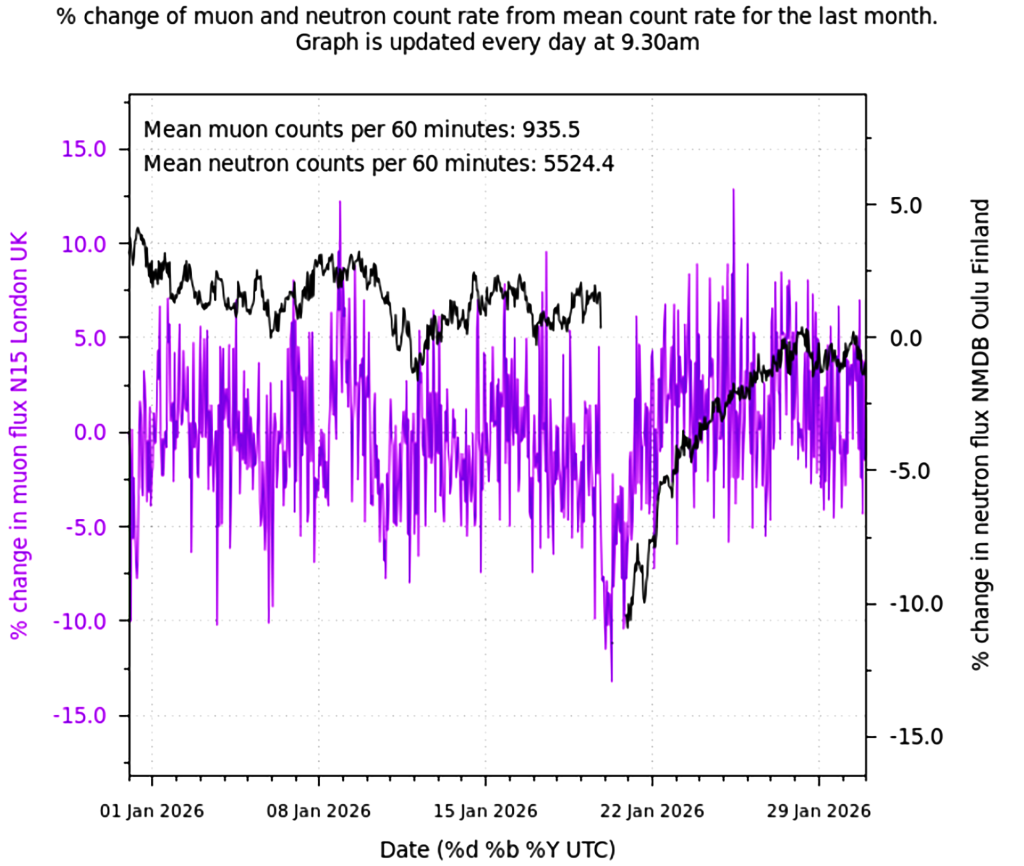
Yes — they’re very likely related. Here’s why:
📡 What happened on 19–20 January 2026
- A full-halo coronal mass ejection (CME) associated with an X1.9 solar flare on 18 January 2026 hit Earth on 19 January. This triggered a severe (G4) geomagnetic storm and elevated radiation conditions that persisted into 20 January.
- This was the result of a large CME impact that arrived late on the 19th, which produced G4 to G2 class geomagnetic storms over the next few days . This fast CME was produced by the large X-class solar flare on the 18th.
🌍 How CMEs affect cosmic rays and muon detectors
Cosmic rays reaching Earth are mostly high-energy galactic particles. When intense solar activity drives large CMEs and associated magnetic disturbances into interplanetary space, those structures modify the local magnetic field environment through which galactic cosmic rays travel. Two key effects occur:
- Forbush decreases — A transient drop in observed cosmic ray (and hence muon) flux when a CME’s magnetic field and shock front sweep past Earth and shield or scatter incoming galactic cosmic rays. These decreases are widely observed in neutron monitor, muon telescope, and similar detector networks.
- Ground Level Enhancements (GLEs) — Sometimes an increase in counts due to high-energy solar particles, but such enhancements depend on the energy and directionality of the solar event. GLEs were not reported for this event, and instead the dominant signature was the decrease.
🧪 Why your muon detector dip matches
The timing of the dip (20 January) aligns well with the CME’s arrival and geomagnetic disturbance. During the passage of the CME’s magnetic cloud and shock structure, the effective galactic cosmic ray flux at Earth’s atmosphere was temporarily reduced — this is exactly the Forbush decrease phenomenon seen in global cosmic-ray networks, including both neutron and muon channels.
In other words:
- The CME disturbed the heliospheric magnetic field.
- This disturbance acted as a barrier/modulator to galactic cosmic rays.
- Muon detectors (sensitive to secondary cosmic rays produced in the atmosphere) registered a significant dip as a consequence.
So, yes — the observed muon rate drop on 20 January is consistent with the effects established by space weather science for strong CMEs and geomagnetic storms.
SIDs are the result of changes to the D layer of the ionosphere. The increased X and extreme UV will increase the ionisation of the D layer causing an increase in the absorption of the RF signal. The D layer dissipates quickly after sunset (no incoming solar X or UV) and reforms around sunrise. That is sunrise and sunset at the mid-point of the path between transmitter and receiver. My understanding is that the ionised layer has two effects of the RF signal, it refracts the signal and absorbes some of its energy. The direction of refraction (up or down) will depend on the angle of incidenc of the signal and the strength of the ionisation (ecectrons/cubic m)
I would be interested if anone can add to this ratheris basic understanding.
Andrew
Interestingly I did not pick up any associated flare activity on my SID Monitor on 19th – but I guess that was due to time of day – too late to detect SIDs?
Andy
The CME impact occurred at 19:15 UTC on the 19th.
From what I understand, the fast moving particles from a large CME (and other sources e.g. fast solar wind streams from coronal holes) can connect and interact with Earths magnetic field lines and appear ahead of the actual impact.
The magnetic field associated with the CME can be strong enough to deflect incoming cosmic-rays that originate from outside the solar system, reducing the neutrons/muons reaching the surface.
Mark
Possibly related to increased solar wind associated with the direct hit CME on 20250119
Martyn