
Does this mean in practice that there is no practical reason to need any other type of feed other than cantenna or loop feed for a small amateur radio astronomy dish for hydrogen line work? And if so where does dipole in Discovery Dish feed fit in?
Andy
When the two are equally well fabricated and tuned, they perform similarly.
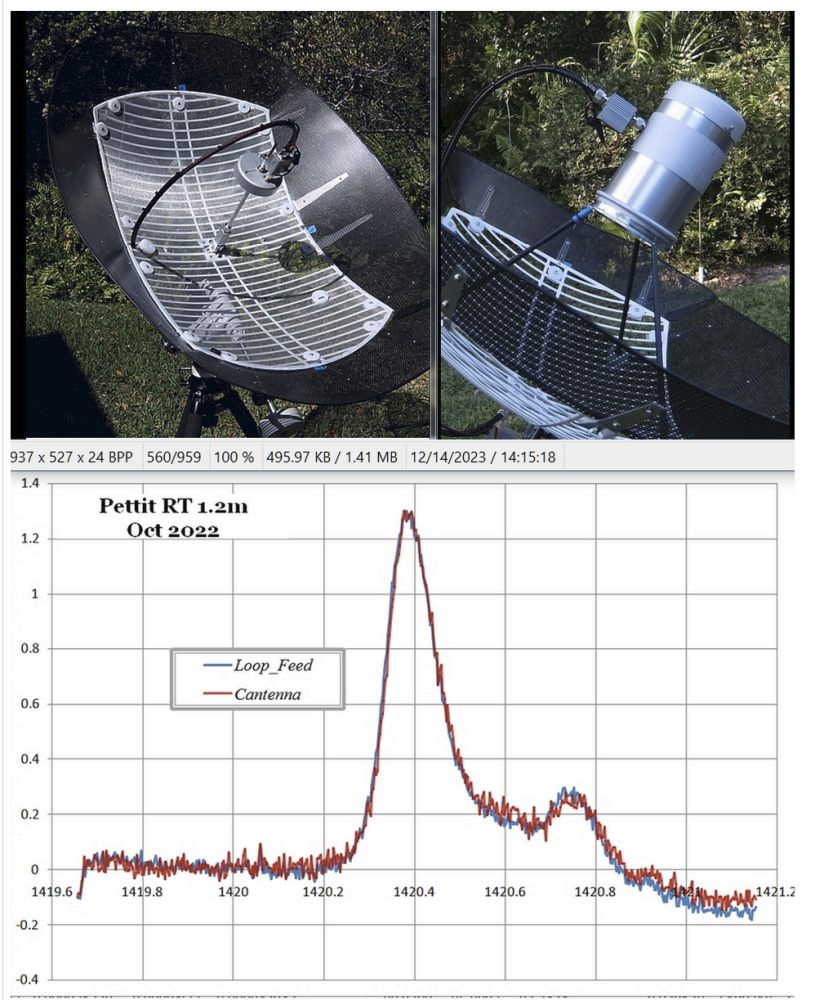
This is getting into a complex discussion .
For Small dishes, loop feeds or cantennas win slightly over dipoles. There is a large benefit from the beam shaping of choke-ringed cantennas.
Various features are important: Design / reliability / production costs / weight / mounting requirements / weatherproofing = There is never one simple answer to these questions.
The “ Dipole ” is not as trivial as it seems : it also incorporates a ” 1/4wl Common Mode Isolation Balun ” in its implementation (At least the Nooelec ‘attempts’ to do so).
Is the balun the short parallel bit at end of coaxial cable before either splits into two arms?
Andy
YES… ( it may not be req’d for a directly connected LNA )
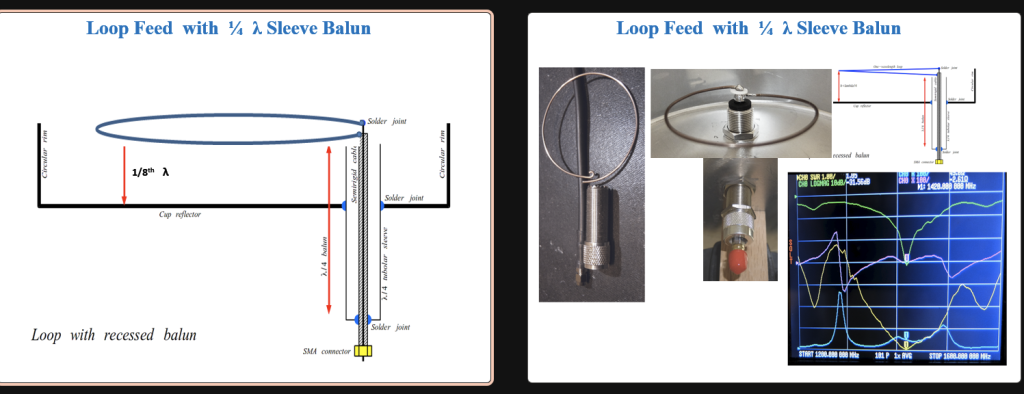
I made one for the Loop Feed (a real pain), but did not see any performance change.
(It is more complex to fab that it may appear due to the need for exact lengths within the sleeve.)
Alex