
Hi Andy,
Just been watching the recent April 2026 Drakes lounge and in particular your piece where you talked about how you worked with Jason to make a conversion between relative RMS power to dB and then used this to make some performance estimates of you cooker dish, really interesting!
This got me thinking that maybe I could try to do something similar and so, as you do, I looked to see how this might be done. I came across this formula which looked somewhat familiar having used this in my solar drift scan HPBW measurements.
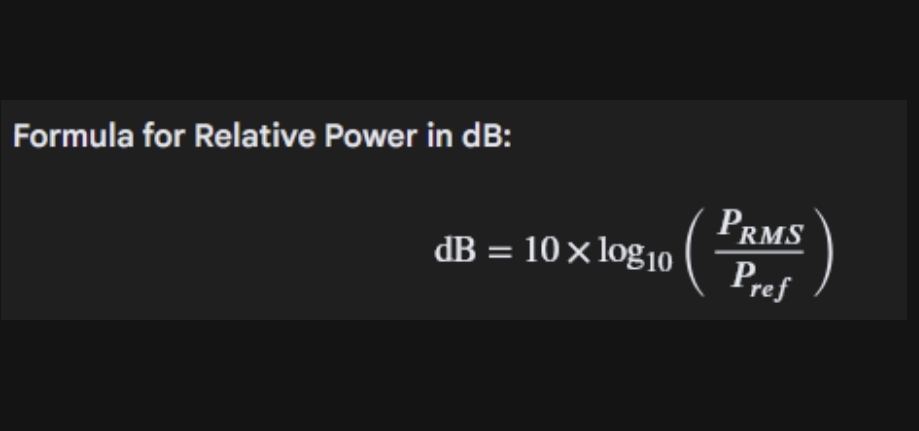
My problem though is what to use for the Pref value? This didn’t worry me much when calculating HPBW as I wasn’t after absolute values but when calculating true dB this is obviously more of an issue.
So, when you made your calculation is that the formula you used and if so what did you use for for your Pref? If you are able to offer any pointers on this then I would be really grateful.
Dave
Response by Jason Burnfield:
Dave,
I use 20*log10(ampl/ref) because the raw data values coming out of the SDR spectra are linear rms amplitude values (i.e. voltage) not rms power. To convert them to rms power you square them and divide by 50. But you can just use 20Log to convert to dB.
You can double check this method by using an attenuator in the path of a known value and seeing if your dB values scale appropriately.
As far as what to use for reference, you can just apply 20 log to the raw amplitude values and that makes it relative dB. Then you can scale it to make the zero point whatever you want after the fact by adding or subtracting a constant value. If your background has a slope or a curve, you can correct for that with a linear or second order curve fit.
I will put together a short tutorial video on how I do that in excel using the raw data file as an input.
Stay tuned!
Jason