
Here is what you need to build your own Cantenna:
- A tin can. Just about any can will do.
- An N Female connector.
- Something to use as radiator probe – a straightened paper clip will work, but probably the best is 1/8 inch diameter copper tubing.
- Some basic tools including a can opener, ruler, drill with 5/8″ bit, awl or nail for punching guide holes, and a marker.
- NanoVNA.
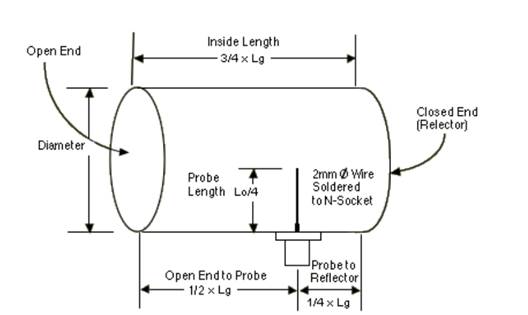
Doing the math:
Use an online calculator, such as the one at https://www.jefatech.com/products/cnfbst?keyword=cantenna, or https://www.changpuak.ch/electronics/cantenna.php, https://www.wikarekare.org/Antenna/WaveguideCan.html to check can size and find out where you are going to mount your connector. The ideal can is between 3 and 4 inches in diameter, although other size cans will work too. Also, the longer the can, the greater the gain you will have.
Dimensions required for building a cantenna:Top of Form
DimensionsDim

I have given below calculations for range of waveguides – note that 120mm diameter can is too small for 1420 MHz, cans need to be 125mm or above in diameter for this frequency.
Bottom of Form

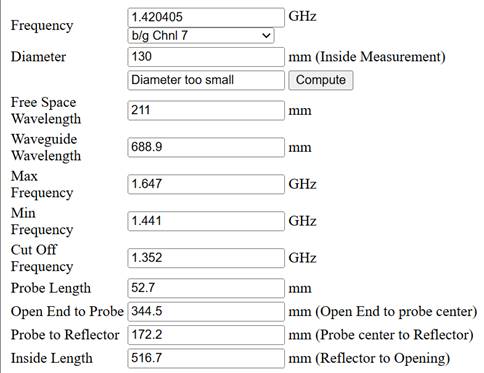
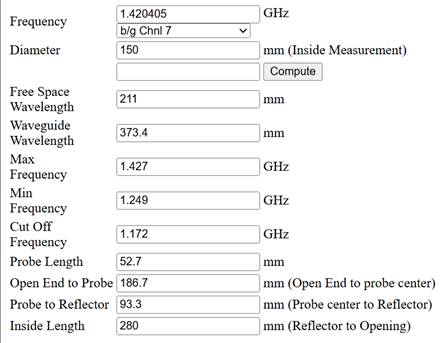
Procedure for building a cantenna:
Using your can opener, remove one end of the can. Hopefully everything will be nice and smooth, but if not, remove any burrs so you don’t cut yourself later on. Empty the contents of the can and wash it out. You can leave the outside label on if you want, that’s up to you.
Solder a radiator probe onto the inner end of the N-type bulkhead connector. Initially this is cut a little longer than required length.
Using the calculator above and your ruler, mark the 1/4 Guide Wavelength measurement from the rear of the can (the side that still has the end)
Using an awl, punch, or nail, punch a pilot hole at the location of the mark you just made.
Drill a 5/8″ hole at this location for your N Female Bulkhead with Radiator.
Insert the N Female Bulkhead with Radiator so that the radiator is inside the can
Install the washer and nut on the connector and tighten in place. You may need to use some pliers to complete this step.
Connect the cantenna to the NanoVNA, and tune the length of the radiator probe by nibbling off tiny bits from the inner end of the radiator until the VWSR is 1:2 or better.