
An X-Band feed has been installed on the 20m Skynet dish at Greenbank Observatory May 2026. What can we observe with it?
Dimitry UA3AVR sent 14 May 2026: X-band on 20 m Green Bank telescope
Hi everyone.
Now the X-band receiver 8000-10000 MHz is switched on. Skynet does not accept observations in L-band. May be somebody knows for how long?
P.S. May be also somebody knows interesting objects for observations in the X-band.
Regards, Dimitry UA3AVR.
From Andrew Thornett (Information from ChatGPT):
The X-band (roughly 8–12 GHz) is a surprisingly rich part of the radio sky—less crowded than lower frequencies but still full of interesting natural and artificial signals. Since you’re working in radio astronomy, this band sits in a sweet spot between atmospheric transparency and compact high-energy sources.
Here are some of the most interesting things you can observe:
🌌 Galactic & Extragalactic Sources
Supernova Remnants (SNRs)
- Strong synchrotron emitters → still bright in X-band
- Key targets:
- Crab Nebula
- Cassiopeia A
- Good for studying spectral index changes (compare with L-band)
Active Galactic Nuclei (AGN) & Quasars
- Compact, bright, often variable
- Ideal for interferometry (you mentioned using RSPduo)
- Examples:
- 3C 273
- Cygnus A
🌠 Galactic Emission
H II Regions & Star Formation
- Dominated by free–free (bremsstrahlung) emission
- Smooth spectrum → still detectable at X-band
- Example:
- Orion Nebula
Galactic Plane Continuum
- Diffuse synchrotron + thermal emission
- At X-band:
- Less synchrotron dominance than lower frequencies
- Cleaner view of thermal components
🪐 Solar System Objects
The Sun (when active)
- Produces microwave bursts during flares
- Strong enough to saturate sensitive setups
- Great for dynamic monitoring
Planets
- Jupiter
- Mostly quiet at X-band (its famous decametric bursts are much lower freq)
- Weak thermal emission detectable with good setup
- Venus
- Strong thermal microwave emitter (thick atmosphere)
🛰️ Artificial Signals (Very Strong!)
Satellites & Spacecraft
- X-band is heavily used for:
- Deep space comms (e.g., NASA DSN)
- Weather satellites
- Radar systems
- You’ll easily detect:
- Passing satellites (Doppler shifts are fun to track)
- Occasional spacecraft carriers
📡 Special Techniques Worth Trying
- Continuum mapping
Scan across the Galactic plane → measure brightness variations - Spectral index experiments
Compare X-band vs your 1420 MHz setup - Interferometry targets
Bright compact sources (e.g., 3C catalog) are ideal - Atmospheric studies
X-band is sensitive to:- Water vapor
- Rain fade (useful calibration experiments)
⚠️ Practical Reality Check
- Hydrogen line (1420 MHz) → not in X-band
- You’ll mostly be doing continuum radio astronomy, not line spectroscopy
- Dish size matters more here (shorter wavelength → narrower beam)
On Friday, May 15, 2026 at 2:36:25 AM UTC-4 Dimitry UA3AVR wrote:
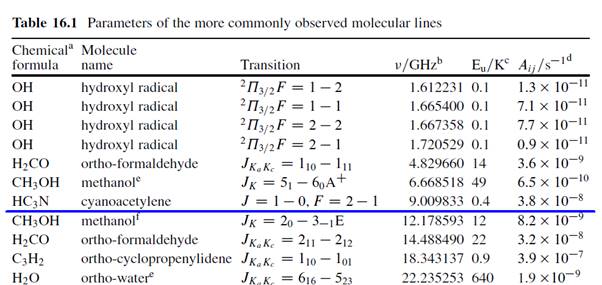
Thanks, Andrew … it seems the natural objects are mostly of continuum spectra. Cas A, Tau A are of measurable fluxes ~500-600 Jy in this frequency band. For spectral observatins, there exists a cyanoacetylene molecule HC3N, see fragment of table from Wilson, Rohlfs, Hüttemeister, Tools of Radio Astronomy, 2013, with relatively high Einstein coefficient A, but it seems rare.
суббота, 16 мая 2026 г. в 02:25:44 UTC+3, Ayushman Tripathi:
Hi Dimitry,
Here’s the info I found on HC3N targets:
• Sgr B2: the strongest HC3N emitter in the sky, this is the original Turner 1971 detection. The J=1-0 line shows weak maser action.
• TMC-1: cold dark cloud (Tk ~10 K), cyanopolyyne-rich. Plenty of J=1-0 literature on this one.
Good paper covering both as HC3N targets (and many more): https://adsabs.harvard.edu/pdf/1976ApJ…205…82M (Morris et al. 1976 multi-source survey)
Also worth a shot: Orion-KL, DR21, IRC+10216 (carbon-star envelope).
Here’s a plot of relative abundances of HC3N for TMC-1, Orion Ridge, and IRC+10216 from Wilson / Rohlfs “Tools of Radio Astronomy” that I got this month and really enjoying it:
X-band RFI to dodge (NRAO list: https://science.nrao.edu/facilities/vla/docs/observing/RFI/X-Band):
• 9300–9900 MHz: SAR satellites + airborne weather radars
• 10740–11600 MHz: terrestrial microwave links
• 11700–12000 MHz: continuous strong RFI along the geostationary belt
The HC3N line at 9.098 GHz sits just below the SAR band at 9.3 GHz, so it’s in one of the cleaner spots in the band.
BTW, HC3N is also observable at higher transitions, J=2-1 at 18.2 GHz, J=3-2 at 27.3 GHz, J=4-3 at 36.4 GHz, etc., spaced ~9.1 GHz apart all the way up to sub-mm.
Thanks!
Ayushman
суббота, 16 мая 2026 г. в 09:04:21 UTC+3, Dimitry UA3AVR:
Thanks, Ayushman, for nice investigation.
The paper reference, the abundance plots, and the RFI analysis are very helpful. Unfortunately, the telescope is currently not operating in high-resolution mode needed for spectral observations; Skynet returns an error when attempting to configure high resolution. TMC-1 and Sgr B levels are strong in comparison to others; nevertheless, detecting them requires at least 500–1000 seconds of tracking (their brightness temperatures ~ hundreds of mK, thanks to ChatGPT). Also, these are rather expensive observations: one second costs one credit, and the current balance of the SARA account is about 2000 credits.
Many regards, Dimitry UA3AVR.