
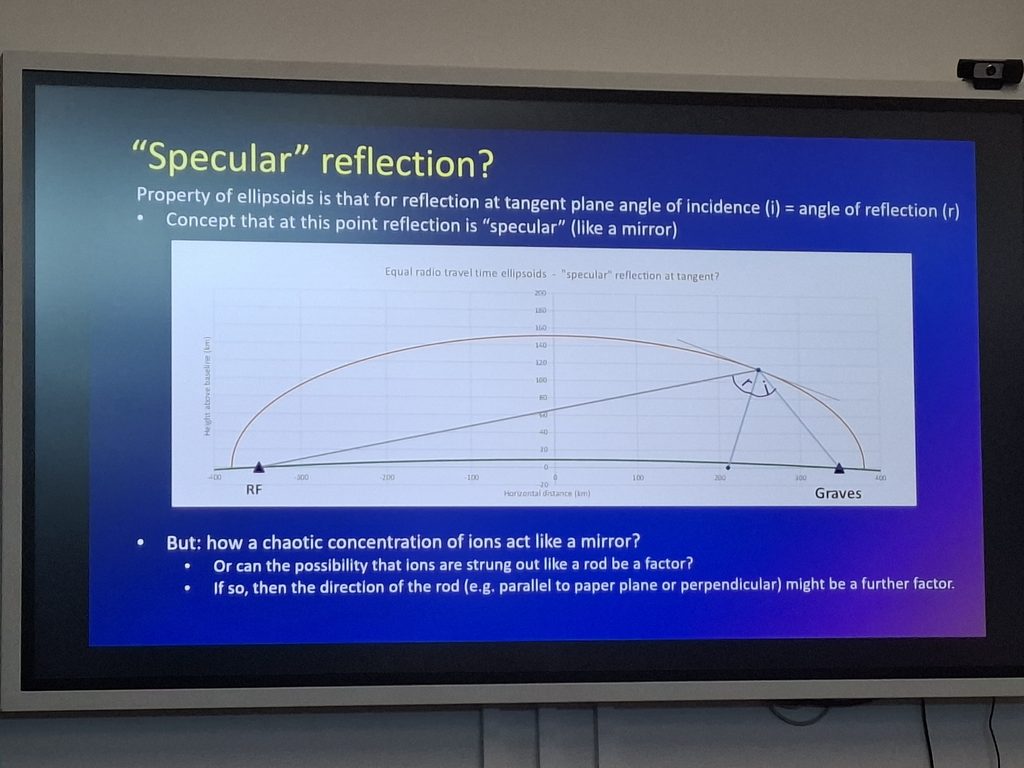
Above From talk by John Savage at BAA Radio Astronomy Conference, Sherwood Observatory, UK, 3 October 2026.
The important point is that the meteor trail does not need to behave like a solid metal mirror. The word specular describes the geometry of the strongest coherent return, rather than implying that the ions form a smooth reflecting surface.
When a meteoroid passes through the upper atmosphere, roughly 80–110 km altitude, it leaves a long, narrow trail of ionised gas containing free electrons. For radio propagation, the free electrons are the important part. An incident radio wave drives those electrons into oscillation, and the electrons reradiate electromagnetic waves.
For an underdense meteor trail, the radio waves scattered by the enormous number of individual electrons add together. Most of the scattered contributions arrive at the receiver with different phases and largely cancel. But at a particular point along the meteor trail, the path length
transmitter → trail → receiver
is stationary: moving a short distance either way along the trail changes the total path length only very slightly. Consequently, radiation scattered from a substantial section of the trail arrives nearly in phase and adds coherently.
That is the origin of the apparently mirror-like reflection.
The ellipsoid on your slide is a useful way of visualising this. Every point on an ellipsoid having the transmitter and receiver at its two foci has the same total path length:
Tx → scattering point → Rx = constant
Where the meteor trail is tangent to one of these constant-path ellipsoids, the phase changes least rapidly along the trail. That’s the specular point.
So the lower question on the slide is actually very perceptive:
“Can the possibility that ions are strung out like a rod be a factor?”
Yes — very much so. A meteor trail is effectively a long, thin plasma column, and its orientation is crucial. It isn’t a random spherical cloud of ions acting as a mirror.
A simplified picture is:
                 Meteor plasma trail
                       /
                      /
                     X   <-- specular point
                    / \
                   /   \
                  /     \
                 /       \
                /         \
               /           \
        Transmitter       Receiver
          GRAVES          your antenna

At X:

   total Tx-X-Rx path is stationary

Electrons around X scatter radio waves.
Their signals arrive at the receiver with
similar phase.

       + + + + + + +  -> strong signal

Elsewhere along trail:

       + - + - - + -  -> mostly cancellation
There is another regime too. If the electron density becomes sufficiently high, an overdense meteor trail can behave more like a conducting plasma surface. The radio wave penetrates only a limited distance and the return can resemble reflection from a plasma cylinder. But even then it isn’t necessary to imagine the individual ions arranging themselves into a polished surface.
One subtle correction to the slide: saying “angle of incidence = angle of reflection” is a convenient geometrical analogy, but for meteor scatter the deeper explanation is coherent scattering plus the stationary-phase condition.
This also explains something very important for your GRAVES meteor observations: you don’t detect every meteor that produces plenty of ionisation. The orientation of the meteor trail relative to GRAVES and your receiving station determines whether the specular geometry exists. A large meteor can therefore give a poor GRAVES echo while a smaller, favourably oriented trail can give an excellent one.