
Amplifier examples relevant to discussion below of receiver chains that involve amplifier before a cavity filter:
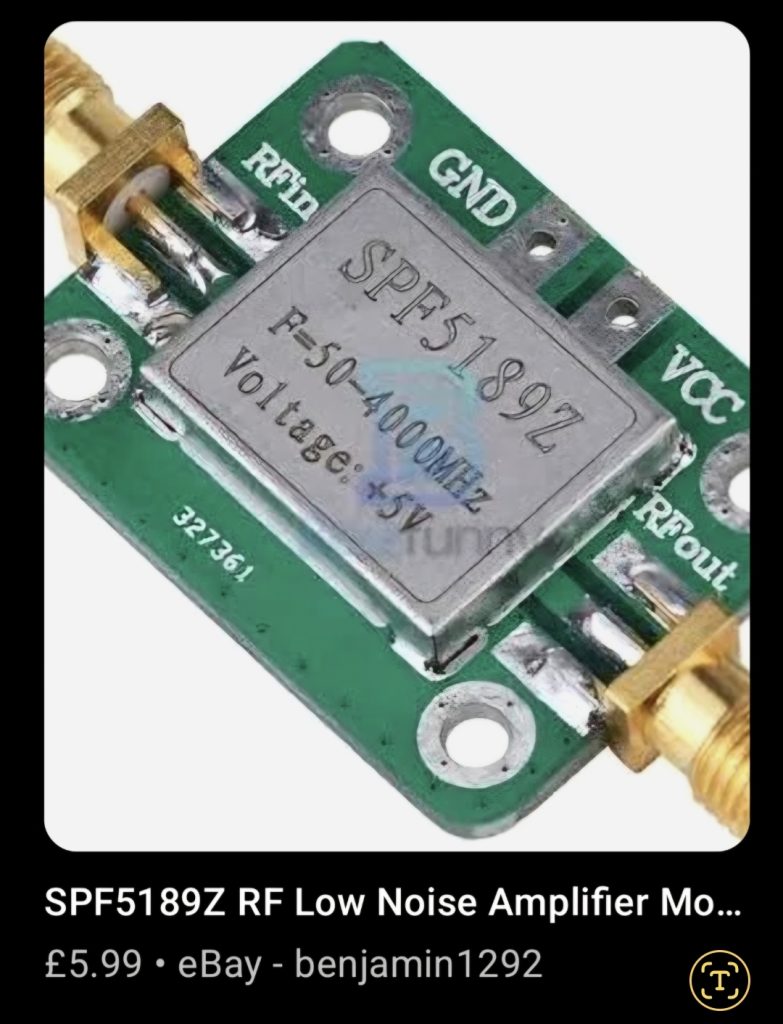
Budget amplifiers:
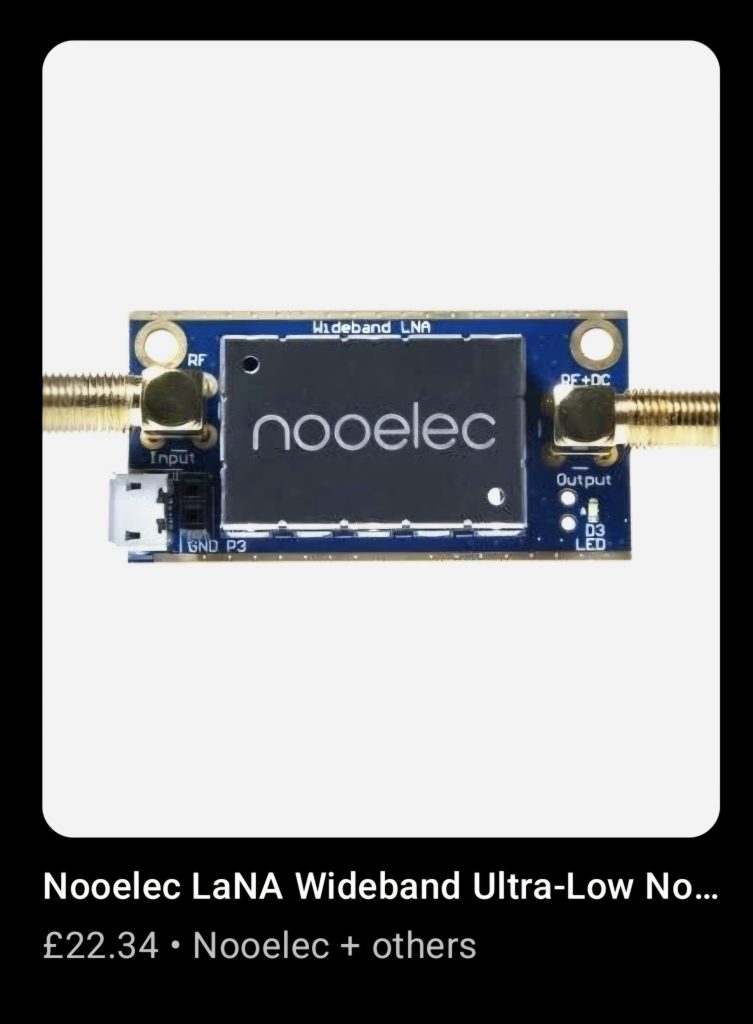
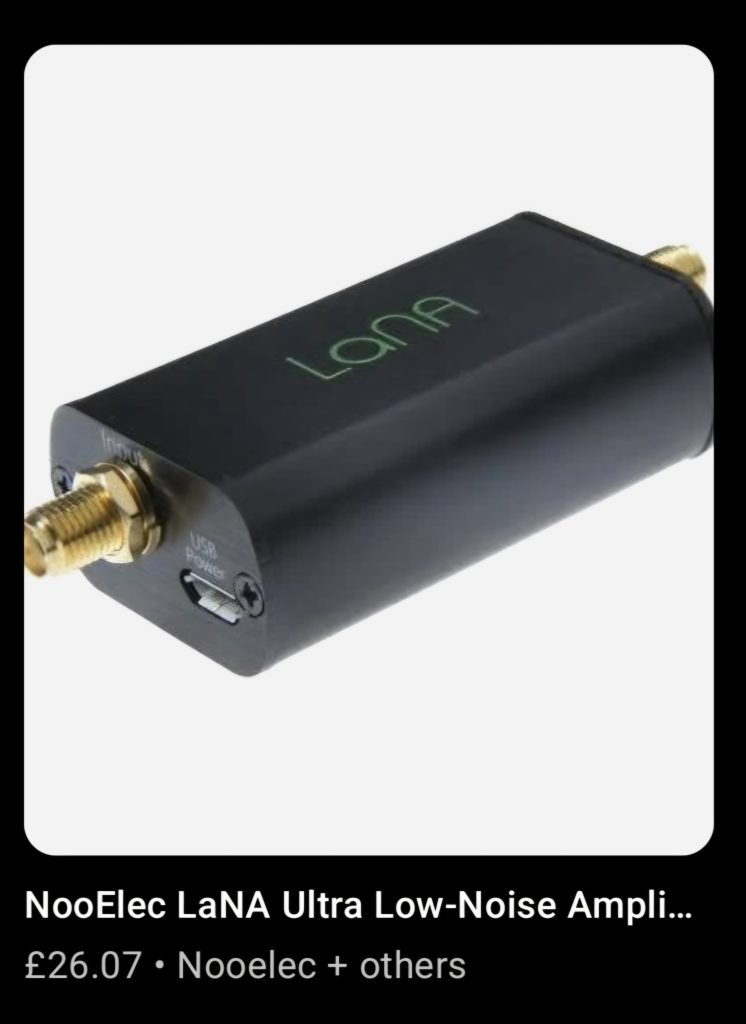
Better quality amplifiers:
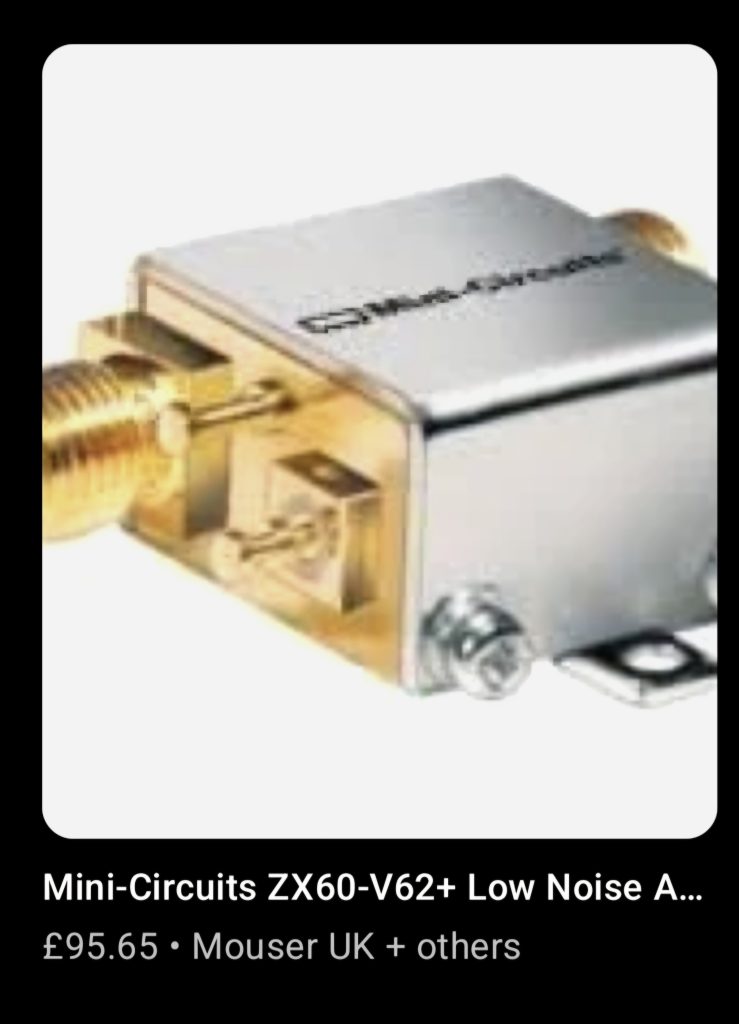
Even better and more expensive amplifiers:
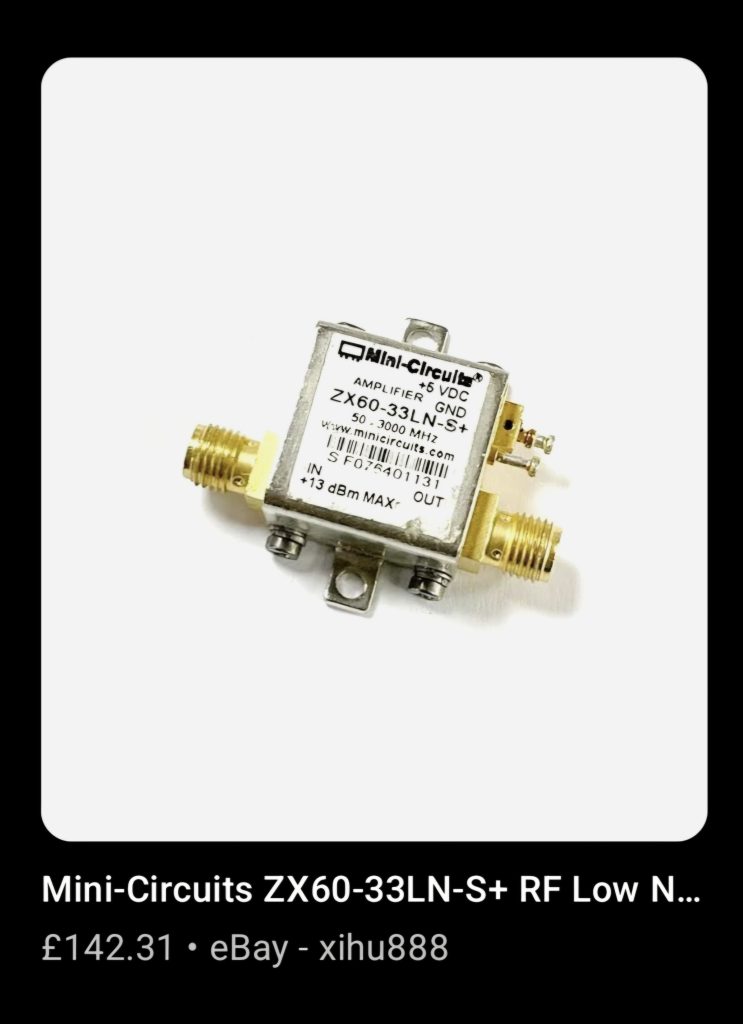
Description:
Yes — a cavity filter + amplifier can sometimes outperform a single Nooelec SAWbird+ H1, but only in certain situations. It depends on noise figure, filter loss, and where the amplifier sits.
Here’s the key comparison.
1. What the SAWBird H1 already does
The SAWBird H1 is designed specifically for the 1420 MHz hydrogen line and already contains:
- LNA → SAW filter → LNA
- ~40 dB gain
- ~0.8–1 dB noise figure
- Bandpass around 1420 MHz with strong out-of-band rejection
The important design feature is:
The first LNA comes before the filter, so the weak sky signal is amplified before the filter’s insertion loss (≈2–4 dB).
That keeps the system noise temperature low, which is critical for radio astronomy.
2. Cavity filter + amplifier
A cavity filter usually has:
- Much narrower bandwidth
- Very steep skirts
- 1–3 dB insertion loss (sometimes more)
That loss matters if it comes before the first amplifier, because it directly increases the system noise figure.
3. When cavity filter + amplifier is better
It can outperform SAWBird if you design it like this:
Antenna → very low-noise LNA → cavity filter → second amplifier → SDR
Advantages:
- Strong rejection of mobile phone / LTE / GNSS interference
- Much narrower passband
- Prevents overloading your SDR
This can be better if you live in a very strong RFI environment.
4. When SAWBird is usually better
For many hydrogen-line setups:
Antenna → SAWBird H1 → SDR
works extremely well because:
- Ultra-low first-stage noise figure
- Filter already optimised for 1420 MHz
- Simple and stable
Adding a cavity filter can sometimes give little improvement but adds ~3 dB loss.
5. Best hybrid configuration (often used)
A very effective chain is:
Antenna
→ ultra-low noise LNA (masthead)
→ cavity filter
→ SAWBird H1
→ SDR
This gives:
- lowest noise
- strong RFI rejection
- lots of gain.
✅ Short answer:
- Yes, cavity filter + amplifier can outperform SAWBird H1.
- But only if the first amplifier has a very low noise figure and is placed before the filter.
For placing an amplifier before a 1420 MHz cavity filter, you want an ultra-low noise LNA with ~0.5–1 dB noise figure and ~15–20 dB gain. The first stage determines most of your system sensitivity.
Below are some of the best practical options used in hydrogen-line receivers.
1️⃣ Very good first-stage LNA (widely used)
Nooelec LANA Low Noise Amplifier
Typical specs:
- Gain ≈ 19 dB
- Noise figure ≈ 0.6 dB
- Frequency range 0.5–4 GHz
This amplifier is often used directly at the antenna before filtering to boost weak signals and compensate for filter insertion loss.
Good chain
Antenna
→ LANA
→ cavity filter
→ SAWBird H1 or second LNA
→ SDR
Advantages:
- Extremely low noise
- Cheap and stable
- Good gain for first stage
2️⃣ Dedicated hydrogen-line LNA (very good)
GPIO Labs Hydrogen Line LNA 1420 MHz
Typical specs:
- Gain ≈ 32–35 dB
- Noise figure ≈ 1 dB
- Tuned specifically for 1420 MHz
Advantages:
- Optimised for hydrogen line
- High gain
Disadvantages:
- Slightly higher noise figure than the LANA
- More expensive
3️⃣ Budget wideband LNA chips (common DIY choice)
Amplifiers based on SPF5189Z or PGA-103:
Typical specs:
- Gain: 15–20 dB
- Noise figure: ≈0.5–0.6 dB
These are often used in astronomy receivers because they have excellent noise performance for the price.
✅ Best practical choice before a cavity filter
| Rank | Amplifier | Why |
|---|---|---|
| 🥇 | Nooelec LANA | Very low noise, ideal first stage |
| 🥈 | SPF5189Z LNA | Excellent NF and cheap |
| 🥉 | GPIO hydrogen LNA | Good but usually better after filtering |
💡 For the setup you are building, the configuration many radio astronomers use is:
Feed
↓
Ultra-low noise LNA (LANA or SPF5189Z)
↓
1420 MHz cavity filter
↓
SAWBird H1
↓
SDR
This gives:
- very low system noise
- excellent RFI rejection
- lots of gain.
Here is a very effective hydrogen-line receiver chain that many serious amateurs use. It improves sensitivity and RFI rejection compared with using a SAWbird alone.
A high-performance 1420 MHz receiver chain
Recommended order
Antenna / feed
↓
Ultra-low noise LNA (mast-mounted)
↓
1420 MHz cavity filter
↓
Second amplifier
↓
SDR (RSPduo in your case)
Why this works:
- The first LNA sets the system noise figure.
- The cavity filter removes strong out-of-band signals.
- The second amplifier restores gain lost in filtering.
Best first-stage amplifiers
Budget but excellent
Typical performance:
- Gain ≈ 18–20 dB
- Noise figure ≈ 0.6 dB
- Frequency range 50–4000 MHz
Advantages
- Extremely cheap
- Excellent noise figure
- Widely used in SDR astronomy front-ends
These chips were designed as high-linearity pHEMT LNAs with about 18.7 dB gain and ~0.6 dB noise figure, making them suitable as a receiver front-end amplifier.
Higher-quality option
Typical specs:
- Gain ≈ 19 dB
- Noise figure ≈ 0.6–0.7 dB
- Good stability and shielding
Advantages
- Better build quality
- Reliable bias-tee operation
- Less oscillation risk
Professional-grade option
Typical specs
- Noise figure ~0.5 dB
- Excellent linearity
- Very stable
Disadvantages
- Expensive
But these are often used in serious radio astronomy receivers.
Example configuration (very effective)
Hydrogen line feed
↓
SPF5189Z LNA (at antenna)
↓
1420 MHz cavity filter
↓
SAWBird H1
↓
SDRplay RSPduo
Benefits
- Very low system noise
- Strong LTE / GPS rejection
- ~60 dB total gain
- Excellent for long integrations.
One improvement many astronomers miss
Place the first LNA directly at the antenna feed with very short coax (<10 cm).
Even 0.5 dB coax loss before the LNA raises system noise significantly.
✅ Best practical choice for your setup
- First LNA: SPF5189Z module
- Filter: 1420 MHz cavity
- Second stage: SAWBird H1
This combination usually beats SAWBird alone by ~2–4 dB SNR in hydrogen-line work.