
The attachments mentioned in the discussion below are available in following downloadable ZIP archive:
Here’s a practical comparison for your dish sizes at the HI line (1420 MHz), assuming a typical aperture efficiency η = 0.60 and system temperature Tsys = 80 K. I’ve computed:
- Gain (dBi)
- Beamwidth (HPBW) in degrees and arcminutes (≈ 70 λ/D)
- Effective collecting area Ae
- SEFD (in Jy), using SEFD ≈ 2kTsys / Ae
I’ve put the full table in an interactive sheet for you to scan, sort, and filter. You can also grab the raw CSV.
Notes on interpreting the numbers
- Wavelength at 1420 MHz: λ ≈ 0.211 m.
- Gain scales as D² and HPBW scales as λ/D, so doubling diameter gives ~4× gain and ~½ beamwidth.
- SEFD ∝ 1/Ae: bigger dishes → lower SEFD → better sensitivity (for the same Tsys).
- If your actual η or Tsys differ, scale accordingly:
- New Ae = Ae × (η_actual/0.60)
- New SEFD = SEFD × (Tsys_actual/80 K) × (0.60/η_actual)
Typical takeaways for your list
- 80–110 cm: Wide beams (HPBW ~8–6°). Great for all-sky mapping and continuum drift scans, limited point-source sensitivity.
- 140–180 cm: HPBW ~5–4°. Good for bright Galactic HI structure and solar/strong continuum.
- 240–300 cm: HPBW ~3–2.5°. Solid for Galactic HI spectra with decent velocity resolution and SNR.
- 500 cm (5 m): HPBW ~1.5°. Substantially better SEFD; discrete H I features and stronger continuum sources become practical in shorter integrations.
- 1000 cm (10 m): HPBW ~0.75°. Strong point-source capability and good spectral sensitivity with modest integration, assuming low RFI and stable calibration.
If you want, I can quickly re-run the table with your measured η (spillover + illumination) and Tsys from your current LNA/filters to get tighter SEFD estimates—or add integration time → expected SNR for typical targets (e.g., Cas A, Cyg A, Galactic plane H I lines) for your SDR/RSPduo setup.
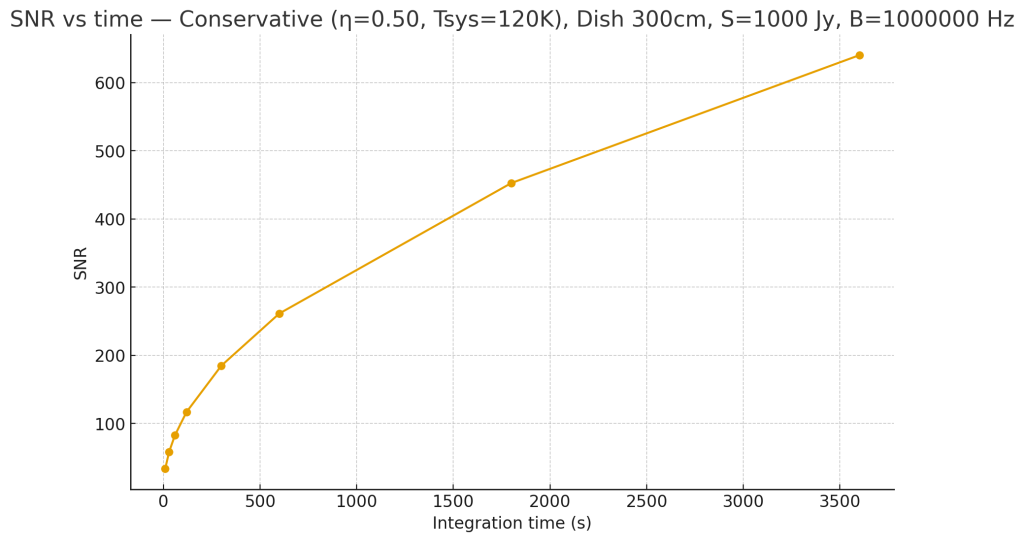
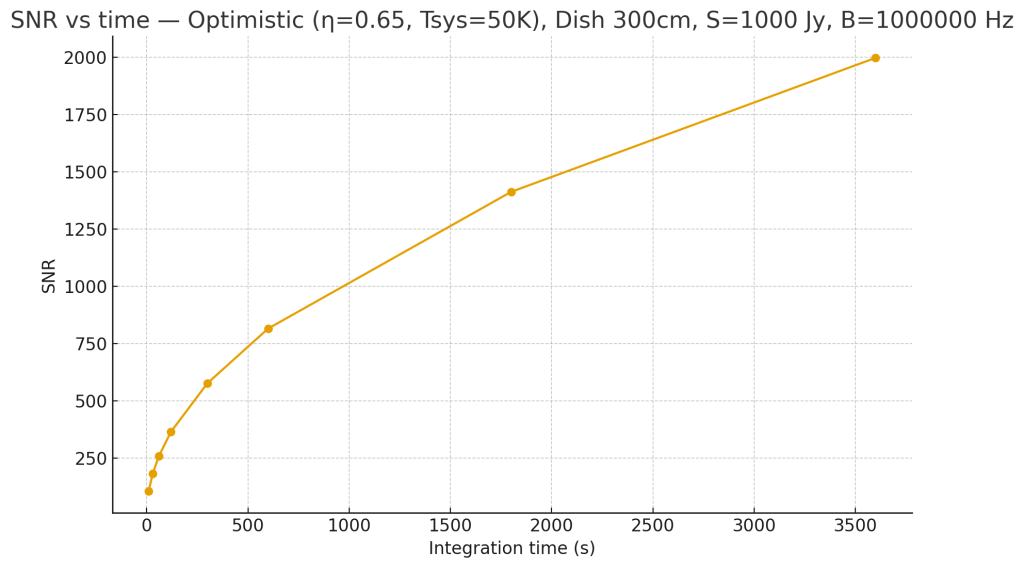
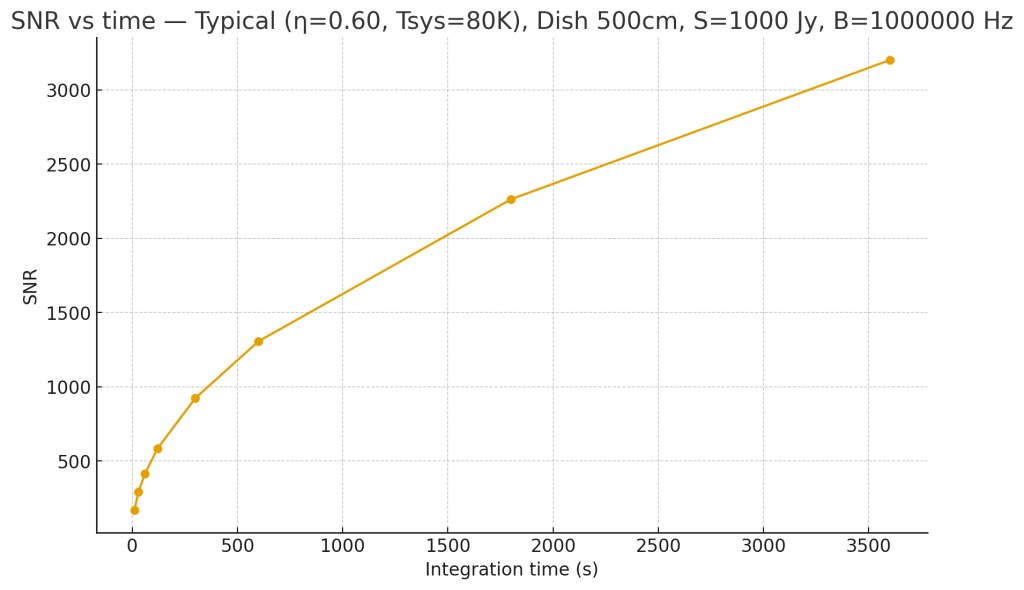
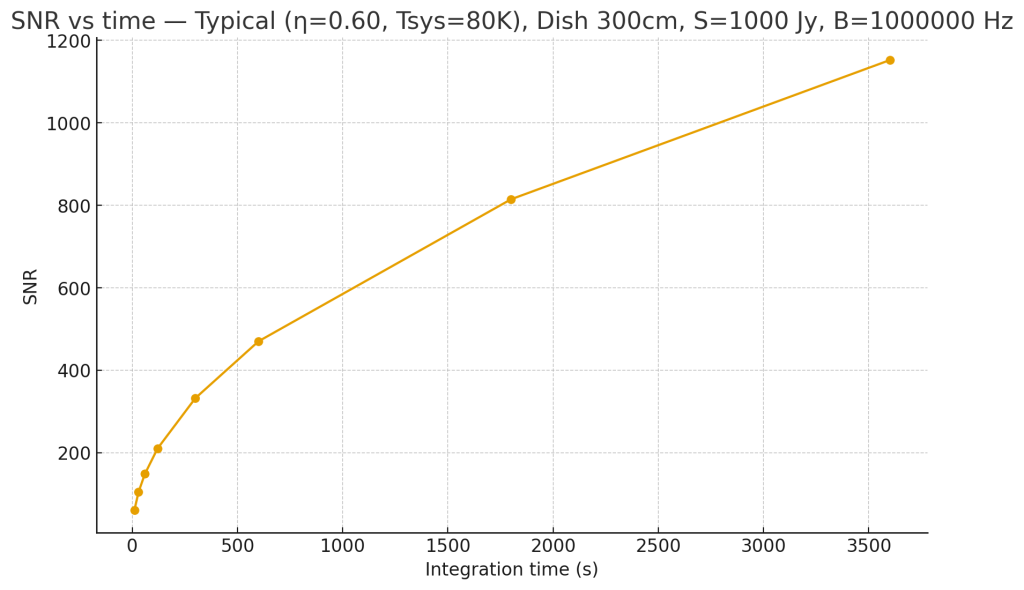
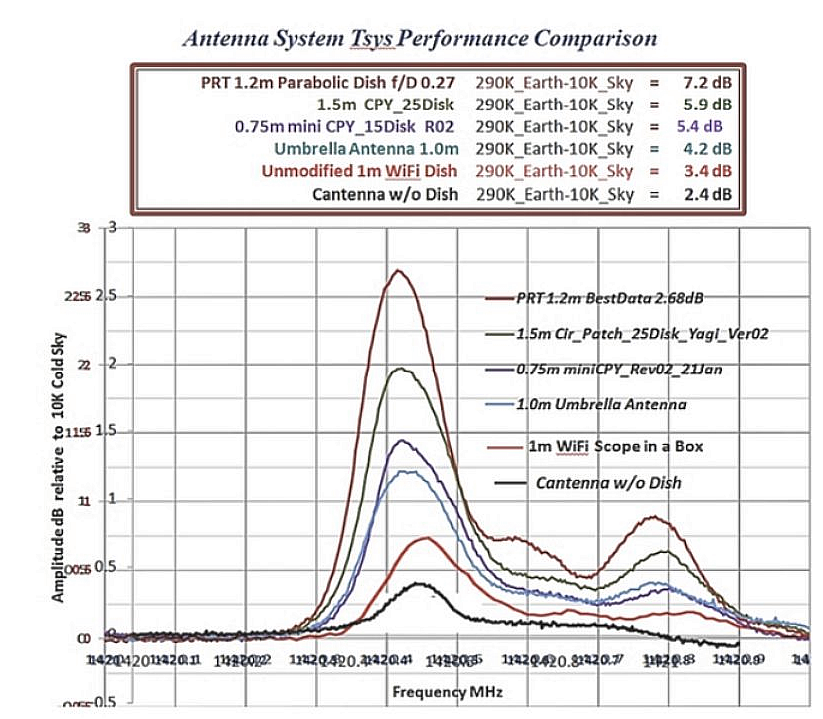
FOLLOWING ABOVE POST, ALEX PETTIT SENT ME THIS INFORMATION AND DIAGRAMS:
Andrew,
I do not understand the “1 dB” reference :
0 dB = a 1 : 1.000 power ratio.
1 dB = a 1 : 1.259 power ratio.
12 m Radio Telescope @ Neu Golm Observatory, Germany
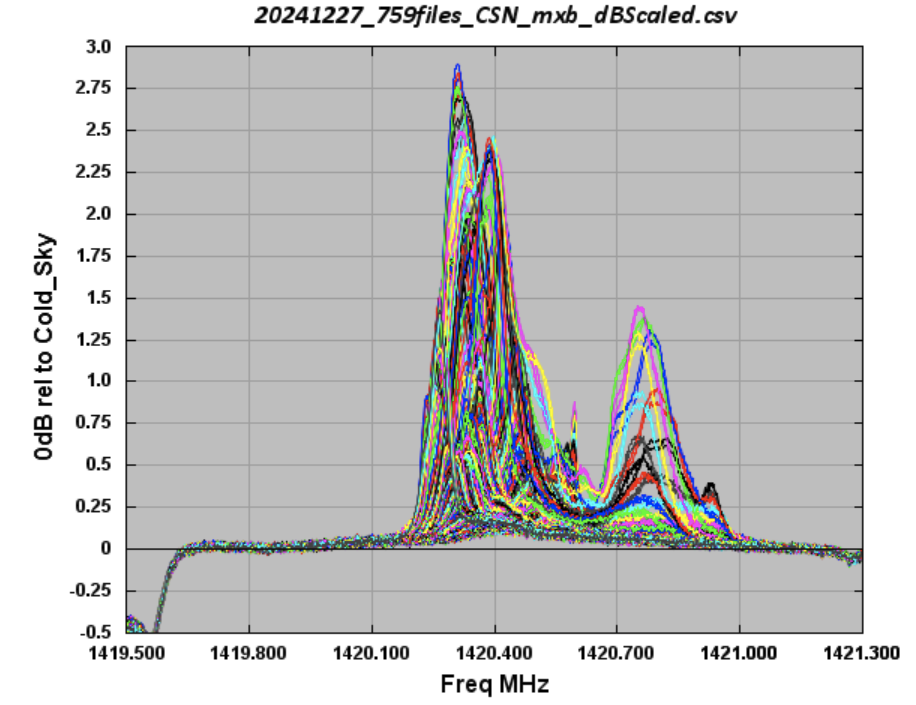
From processing data acquired by dishes up to 12.0 meters,
about +3 dB over cold sky is the max from a distributed source as Galactic H Clouds