
Yes. A small 1420 MHz test transmitter can be a useful way of checking a two-dish interferometer, but there is one important complication: if you walk close to the dishes, you are testing the interferometer in its near field rather than reproducing a celestial plane wave. It can still be an excellent functional test.
For a simple test, I would do this:
- Use a very weak 1420 MHz source. Ideally use a signal generator feeding a small 1420-MHz antenna through substantial attenuation. You need surprisingly little power at garden distances. Keep it weak enough that neither receiver nor LNA is being driven into compression. Also, because 1420.0–1427.0 MHz is internationally allocated to passive radio astronomy, avoid radiating a test signal unnecessarily; a screened/very-low-power setup or a frequency outside the protected band is preferable. My own tests use a NanaoVNA set to its minimum power output 2dB on CW to get constant frequency and with 90dB extra external attenuation on its output channel.
- Put both dishes side-by-side on the same baseline, pointed toward the area across which you’ll walk. Make sure the source remains inside the main beam of both dishes.
- Make the two receiving chains as identical as practical—dish → feed → LNA/filter → receiver—and use the same frequency/time reference where your interferometer requires it.
- Rather than walking randomly toward or away from the dishes, walk sideways across their field of view, roughly along a line parallel to the baseline:
                  TEST SOURCE
              * ---> ---> ---> *
                 walking path

           distance R (as large as practical)


       Dish A                 Dish B
         \                      /
          \                    /
           \                  /
            \                /

             <--- baseline B --->
- Move slowly and steadily. Record the interferometer output continuously. If everything is working, changing your position changes the difference in path length from the transmitter to the two dishes. The relative phase should therefore rotate and produce maxima and minima in the correlated output.
Figure: Calculating distance need to move signal generator to see a new fringe at 1.42GHz:
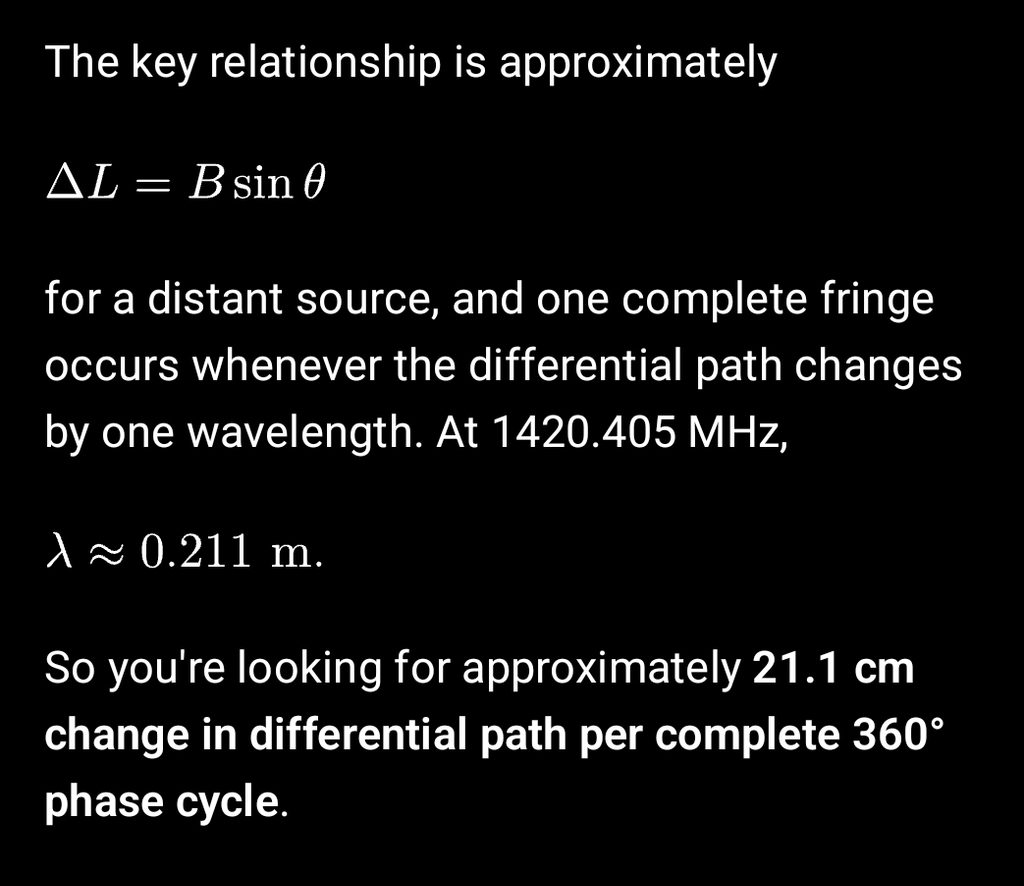
So you’re looking for approximately 21.1 cm change in differential path per complete 360° phase cycle.
An even better experiment
Don’t actually walk with the generator. Put it on a tripod or pole and move it between accurately measured positions. For example, mark positions every 10 or 20 cm along a tape measure. Record 10–20 seconds at each position.
That gives you something you can plot:
Correlation
    ^
    |       /\        /\        /\
    |      /  \      /  \      /  \
    |_____/    \____/    \____/    \____
    |
    +------------------------------------> transmitter position
You can then compare the measured fringe positions with the predicted path difference calculated from the actual distances to Dish A and Dish B:
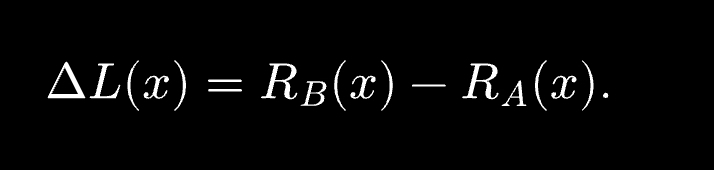
For your garden-scale experiment, I’d use that exact distance calculation rather than the far-field \(B\sin\theta\) approximation.
If you tell me your dish separation (baseline) and approximately how far in front of them you can put the transmitter, I can calculate exactly where you should place the transmitter and approximately how many centimetres you need to move it between successive fringes.