
From Alex (originally posted on SARA Mailing list 22/8/2026):
Observe the relative Signal Strengths & Signal/Noise of each:
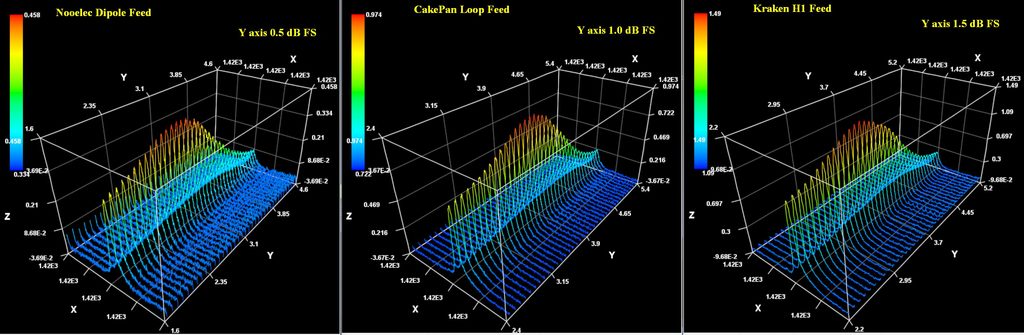
These 3 hour drift scan data sets were acquired using 300 second averages and
SDR# > IFavg > HL3D > Rinearn3D software
From Adrian Claussal (originally posted on SARA Mailing list 23/8/2026):
The Discovery Dish Team’s Kraken hydrogen line feed PCB figures that Alex shared appears to be of a very broad‑bandwidth radiator design. Without someone actually putting it on a VNA or spectrum test bench, it’s hard to say exactly what bandwidth it covers, but the design cues strongly suggest a wide frequency response, and at minimum it seems well‑matched to the LNA input impedance. It could be that Kraken even uses the same PCB radiator across their entire product line, much like NooElec attempts to do, and that the primary differences between applications come from the LNA and the SAW filter choices for each specific band they support. If that’s the case, the wideband PCB element would serve as a general‑purpose radiator, while the band‑defining selectivity and gain characteristics would be handled almost entirely by the front‑end electronics. One would have to see examples of their other product PCB to get some idea if this is true.
The clues are in the geometry. The broad radiating elements are a hallmark of wideband behavior, whether in a monopole, a PCB trace radiator, or any other planar antenna. Even more telling is the stepped section — the part that looks like a staircase. That feature is directly analogous to the element scaling used in a log‑periodic dipole array (LPDA). Log‑periodic antennas are intentionally designed to cover multiple octaves of frequency, and they use asymmetrically coupled resonant elements to smooth the overall response. The PCB pattern on the Kraken feed shows the same design philosophy: multiple differently sized segments, each contributing resonance over a different part of the band.
Beyond visual inspection, it’s hard to say more about the exact resonant behavior of the PCB elements, but the additional impedance‑transforming section — stepping from a very high feed impedance down to something the LNA can accept — helps make the radiator less sensitive to the wide frequency range it’s intended to cover.
Alex is also correct about the waveguide nature of a cantenna. A cantenna has inherent frequency selectivity because its dominant mode (TE₁₁ or TEM‑like depending on geometry) only propagates efficiently over a narrower band. That natural selectivity can help reject nearby RFI sources such as cellular bands. A well‑designed cantenna feed, properly matched to a specific observing frequency, should perform as well as the Kraken PCB radiator in terms of frequency discrimination.
The efficiency and characteristics of the front end electronics then provide the system differentiations from each other. The Kraken feed has one major advantage: its integrated LNA. The LNA is likely superior to what most people bolt onto a cantenna, and because it’s directly connected to the PCB radiator with no cables, connectors, or transition losses, the overall noise performance is better. The absence of connector interfaces eliminates several tenths of a dB of loss right at the front end, which matters enormously for weak‑signal work.
Finally, the Kraken feed — with its near‑field reflector beam forming function and most likely the actual PCB radiator itself — was almost certainly designed, at least to some degree, for the small Kraken dish they also sell. That dish’s F/D ratio and illumination characteristics are not the same as the wide variety of random dishes people are using in the field. Because of that, the Kraken feed, which is not easy (and in some cases not really possible) to modify or re‑optimize for other dishes, cannot be expected to perform equally well on every other dish it is placed on. Its efficiency and illumination will vary, and in some cases may be noticeably reduced, simply because it was never intended to be used on those geometries.
Finally, I’m not advocating for the DD feed, but the reason I went into all that detail is simply because its design, bandwidth behavior, and dish‑specific illumination make a direct comparison to a cantenna on a large dish far less straightforward than it might seem.
Adrian