
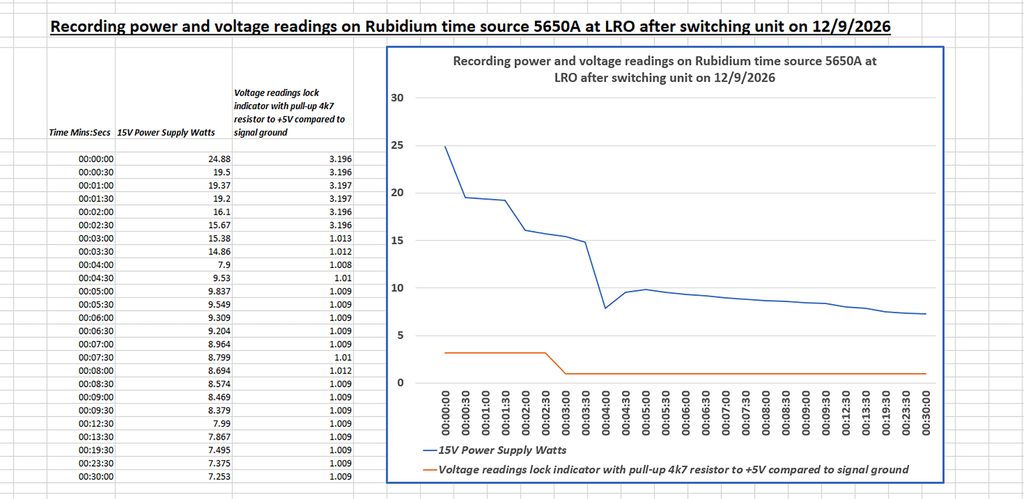
That completes the picture very nicely. The 30-minute run looks highly repeatable and stable.
The important observations are:
- 0–2½ min: Pin 3 stays essentially rock-steady at 3.196–3.197 V, while 15-V power falls from 24.88 W → 15.67 W.
- Between 2:30 and 3:00: Pin 3 makes an abrupt transition from 3.196 V → 1.013 V. That is clearly a discrete status change, not gradual thermal drift.
- 3–4 min: Pin 3 remains at ~1.01 V while heater power continues falling.
- At ~4 min: there is a major reduction in power from 14.86 W at 3:30 → 7.90 W at 4:00.
- There is then a small thermal-control overshoot/recovery to ~9.8 W, followed by a slow decline.
- 30 min: power has settled to 7.253 W, while Pin 3 remains exceptionally stable at 1.009 V.
So your measured sequence is approximately:
POWER ON
   │
   ├── +15 V supply
   └── +5 V supply
          │
          ▼
       WARM-UP
          │
          │  Pin 3 ≈ 3.196 V
          │
          │  24.9 W
          │     ↓
          │  15.7 W
          │
       ~2½–3 min
          │
          ▼
   PIN 3 STATUS CHANGE
   3.196 V → 1.013 V
          │
          ▼
    ~3–4 minutes
          │
          ▼
   MAJOR HEATER REDUCTION
   ~14.9 W → ~7.9 W
          │
          ▼
   thermal regulation
    ~9.8 W initially
          │
          ▼
     gradual settling
          │
          ▼
       30 minutes
       7.253 W
       Pin 3 = 1.009 V
          │
          ▼
    STABLE OPERATION
The particularly convincing result
Your Pin-3 measurements are remarkably consistent. Before the transition they’re about 3.196 V; afterwards virtually every measurement is 1.008–1.013 V, right through to 30 minutes.
That makes it extremely unlikely that what we’re seeing is simply an accidental voltage caused by the heater load. Something inside the 5650A is deliberately changing the electrical state of Pin 3 at approximately three minutes.
There’s also a useful distinction between two events:
~3 min: electrical status changes
then
~4 min: heater demand drops dramatically
That is exactly the sort of relationship worth documenting.
I would now regard this as a successful repeatability test. The next particularly valuable experiment would be to record 10-MHz output frequency simultaneously with these two measurements, especially across the 2:30–4:30 interval. That would let us correlate Pin-3 transition + heater power + frequency behaviour and make a much stronger case for what Pin 3 is actually indicating.