
Airspy HF+ Discovery and Airspy HF+ are closely related, but the HF+ Discovery is the improved second-generation design. For weak-signal work (including radio astronomy experiments) the Discovery is generally the better choice.
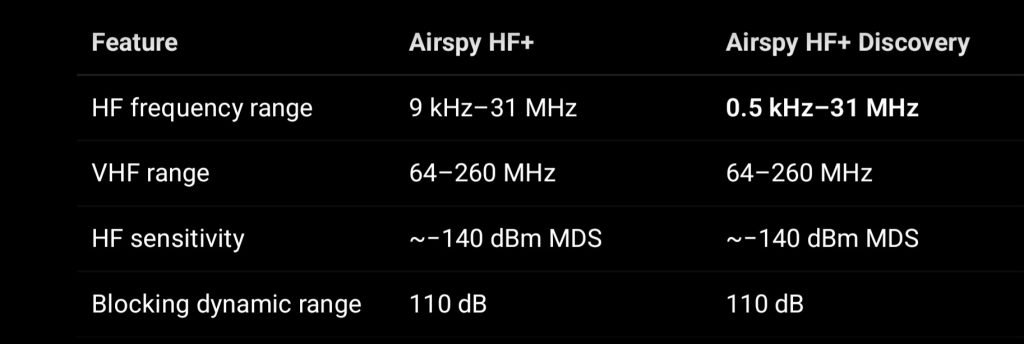
The important differences are:
1. Better front end on the Discovery
The HF+ Discovery adds more sophisticated band-tracking preselectors and improved RF filtering. This helps when you have strong local signals (broadcast stations, nearby transmitters) because they are less likely to overload the receiver.
2. Lower frequency coverage
The Discovery extends down to about 500 Hz, whereas the original HF+ starts at about 9 kHz. This is useful for VLF/LF work.
3. Radio astronomy relevance
For your hydrogen-line work at 1420 MHz, neither is suitable directly — they stop at 260 MHz. But for:
solar radio monitoring at HF/VHF,
meteor scatter experiments,
VLF SID monitoring,
HF propagation studies,
the Discovery would be the preferred unit because of its cleaner front end.
For 21 cm hydrogen-line work, your SDRplay RSPduo, Airspy R2 (with suitable converter), Pluto, or a dedicated 1420 MHz receiver remain more appropriate.
Bottom line
Already have HF+? The upgrade is not essential unless you need very strong-signal environments or VLF below 9 kHz.
Buying new? Buy the HF+ Discovery. It is the more refined receiver and is usually the one chosen for serious HF weak-signal work.
One interesting comparison for your observatory would be Airspy HF+ Discovery vs SDRplay RSP1B/RSPduo for radio astronomy-style narrowband measurements — they have quite different strengths.