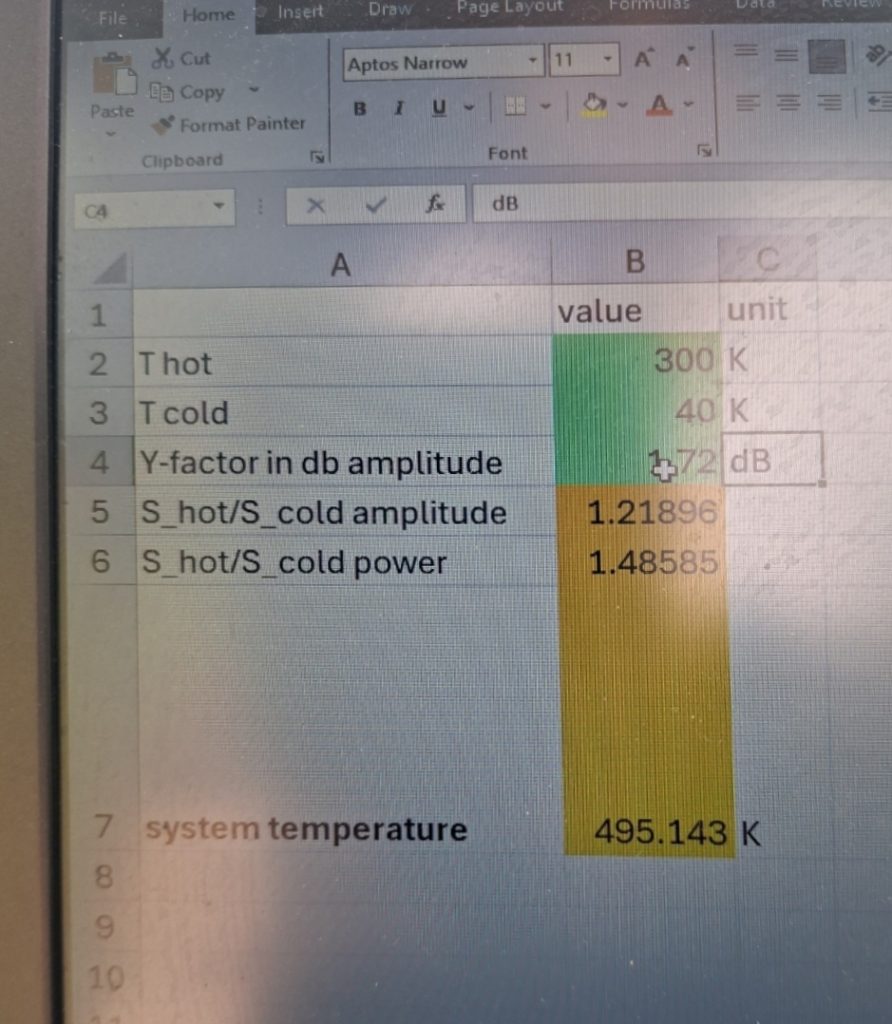
Yes, your spreadsheet is set up in the right way provided that the 1.72 dB is a power Y-factor.
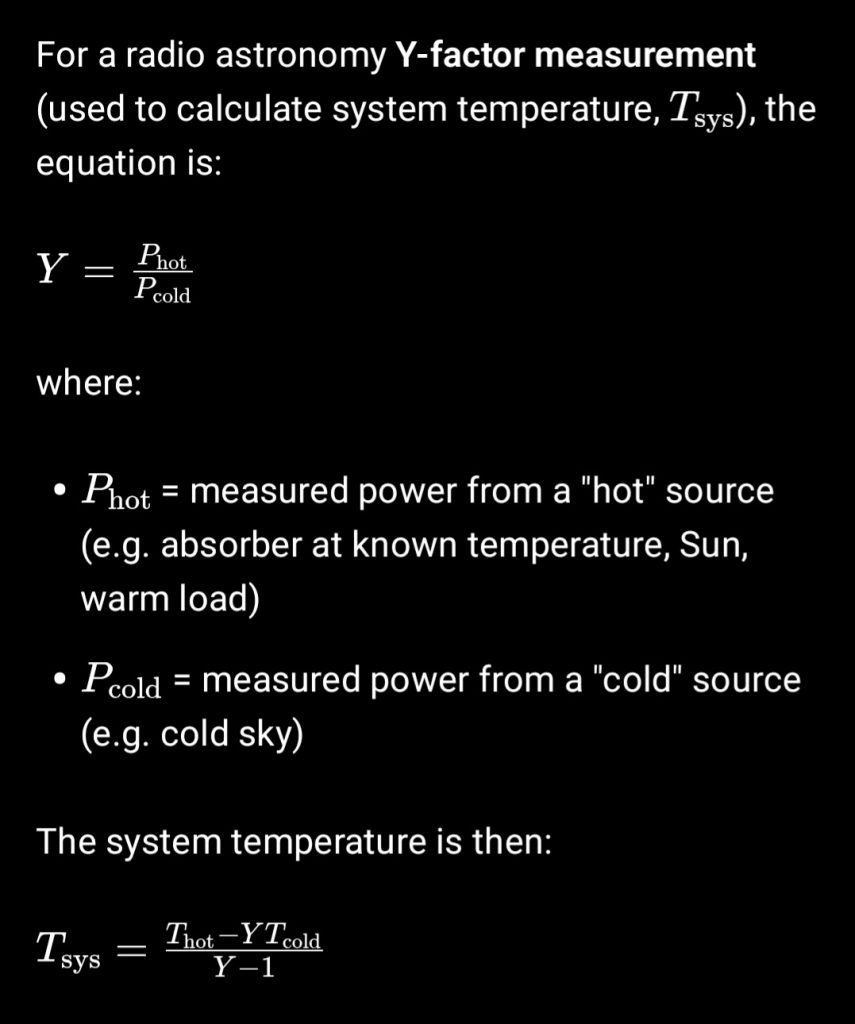
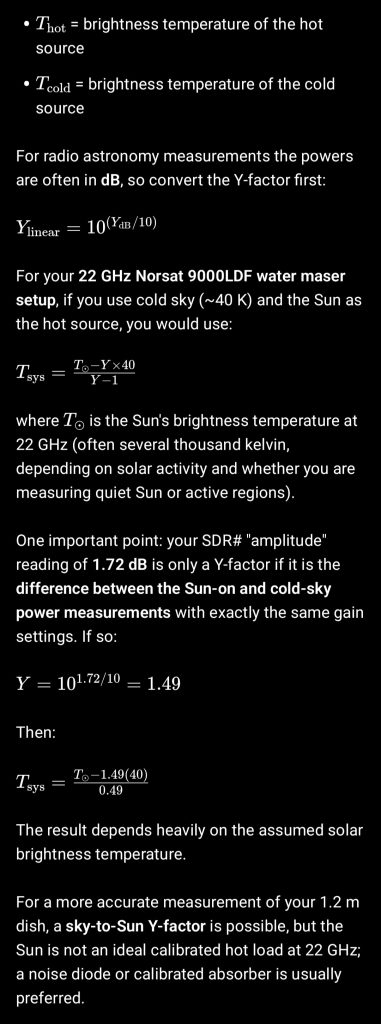
where (Y) must be a power ratio, not an amplitude (voltage) ratio.
A value of 1.72 dB corresponds to \[ Y = 10^{1.72/10} = 1.486 \]
which is exactly the 1.48585 shown in your spreadsheet, so that part is correct if SDR Sharp is reporting power in dB.
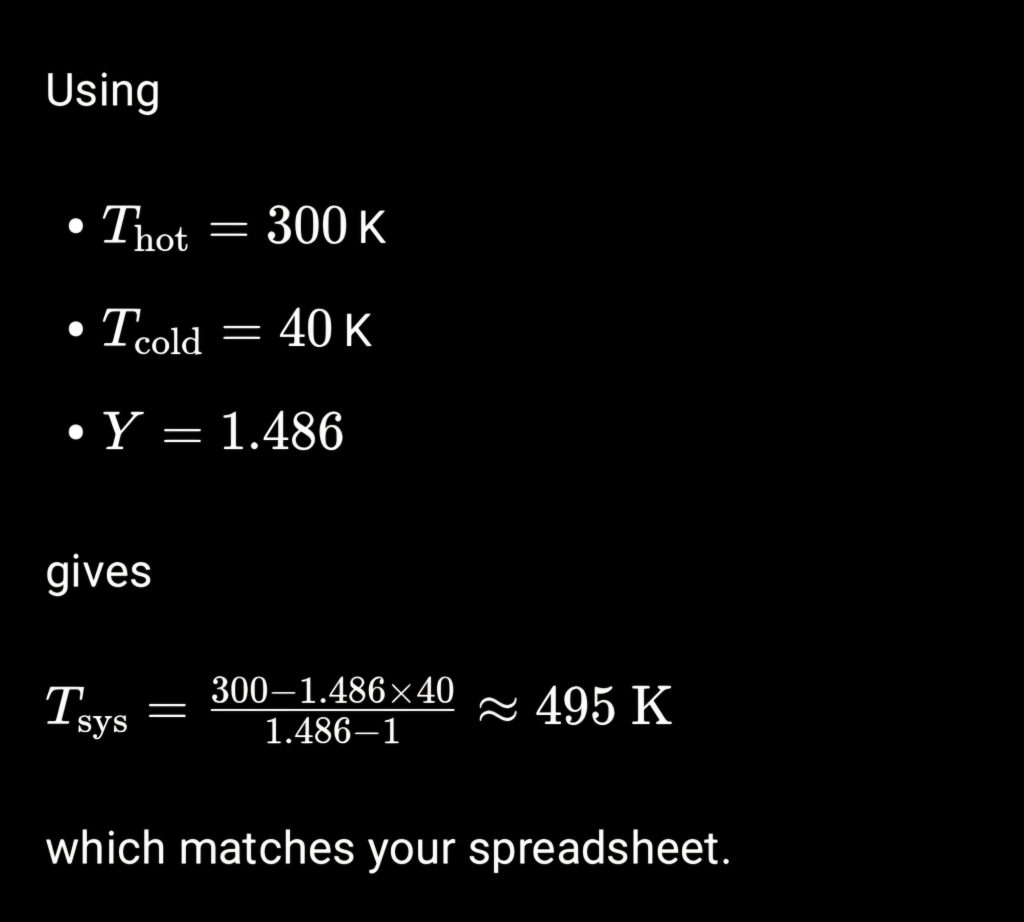
Is 495 K reasonable?
For a 1.2 m dish at 22 GHz with a Norsat 9000LDF, I’d say yes, it is plausible, though perhaps a little on the high side.
Typical contributions might be approximately:
- LNB noise temperature: 120–200 K (depends on model and frequency)
- Atmospheric emission at 22 GHz: 50–150 K (very weather and elevation dependent because you’re close to the water vapour absorption line)
- Spillover and ground pickup: 50–150 K
- Feed losses and waveguide losses: 20–50 K
- Other losses: 20–50 K
That can easily total 300–550 K, especially if the dish is at a modest elevation or conditions are humid.
One thing I’d check carefully
You mention “Signal Diagnostics power level (amplitude really)”.
This is important.
If SDR Sharp is displaying an amplitude in dB (20 log₁₀), then the power ratio should be:
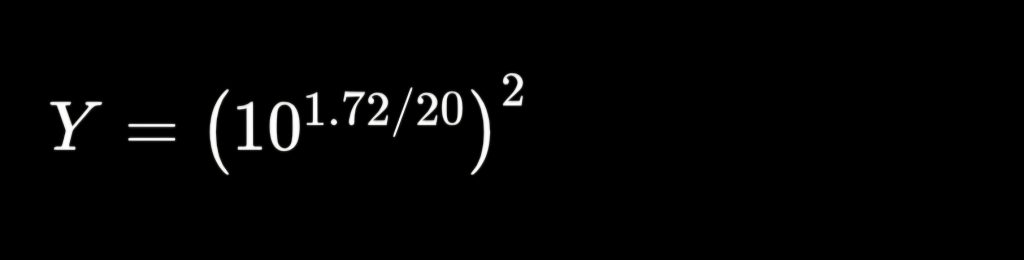
which works out to exactly the same 1.486 because squaring the voltage ratio converts it to power. So if you entered 1.72 dB and converted using 10^(dB/10), you’re still effectively using the correct power ratio.
However, if you measured linear amplitudes rather than dB, you would need to square the ratio before calculating \(T_\text{sys}\).
I have one question
How did you make the hot and cold measurements?
- Was the hot load a microwave absorber (or absorber-covered feed) at room temperature?
- Was the cold load the clear sky near the zenith?
- Or was the cold measurement made another way?
Also, what elevation angle was the dish pointing at for the cold-sky measurement? At 22 GHz, the atmospheric contribution changes significantly with elevation, so the assumed 40 K may or may not be appropriate.
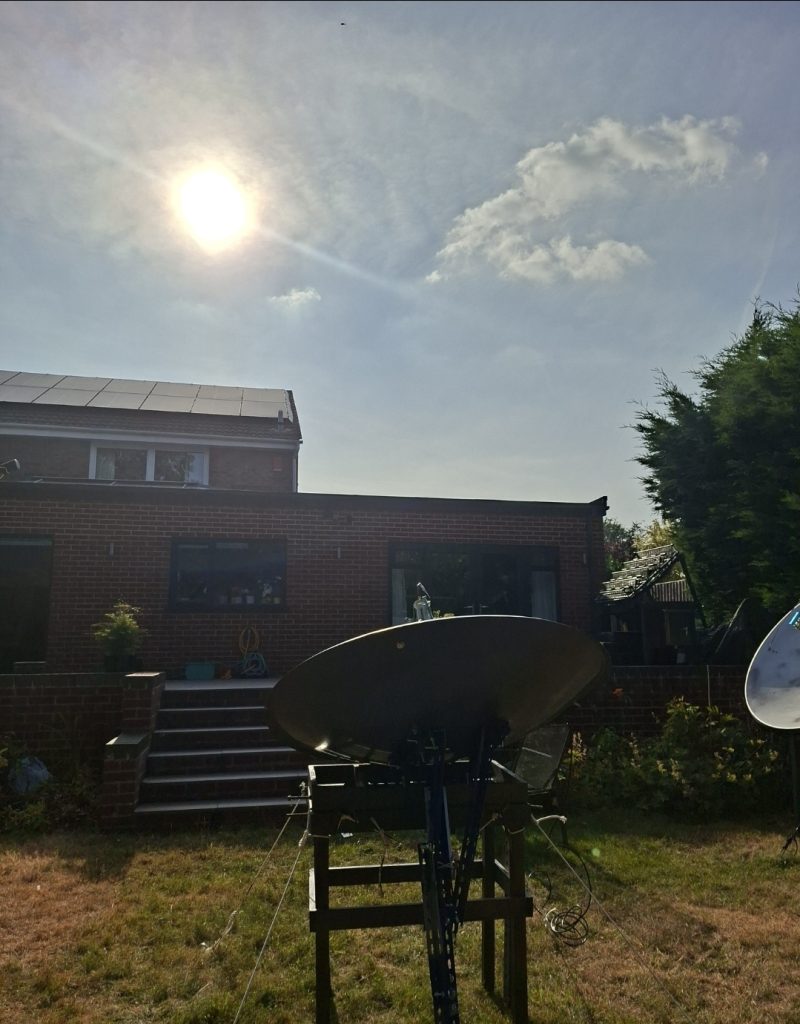
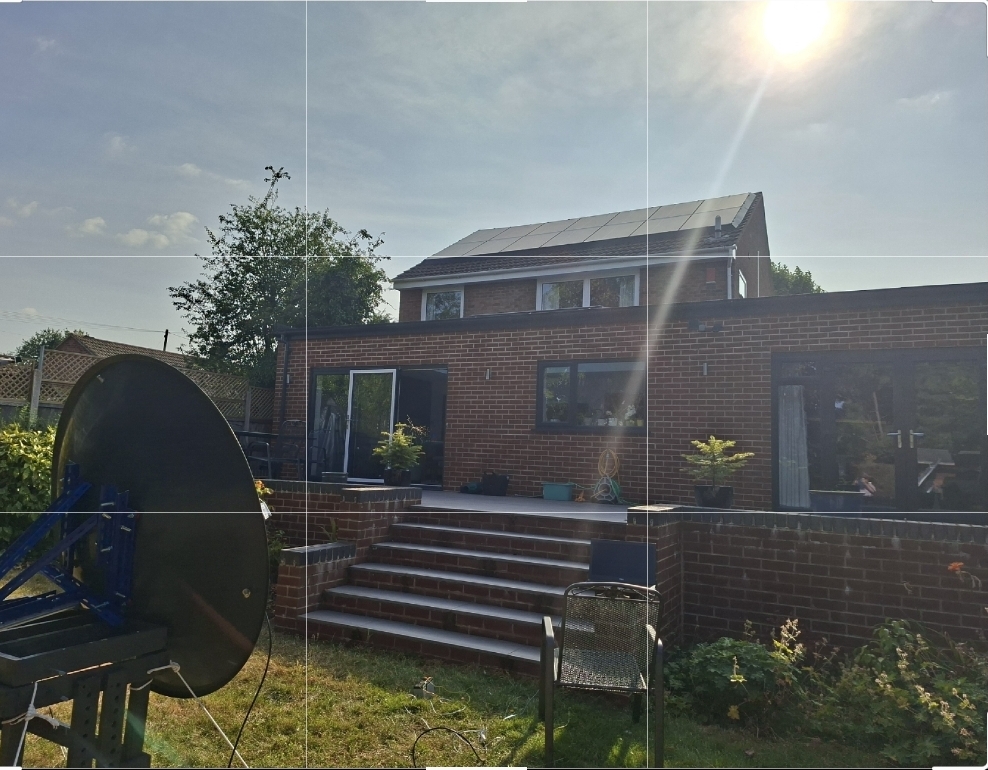
Photo of the position of dish, house and Sun during hot measurement:
And during cold sky measurement: