At the hydrogen line (21 cm wavelength, 1420 MHz), many common structural materials are essentially transparent provided they are non-conductive and not loaded with carbon or metal.
For bracing a dish, the key is that the brace should ideally not cross the aperture in front of the reflector. If it must be near the RF path, here are some good choices:
| Material | RF Transparency at 1420 MHz | Weight | Cost | Notes |
|---|---|---|---|---|
| PVC pipe | Excellent | Light | Very low | Common choice for antenna supports. |
| uPVC electrical conduit | Excellent | Very light | Very low | Often the best value. |
| Fiberglass rod/tube | Excellent | Light | Moderate | Widely used for antenna masts and spreaders. |
| HDPE pipe | Excellent | Light | Low | Similar RF properties to PVC. |
| Polypropylene tube | Excellent | Very light | Low | Mechanically less stiff. |
| Balsa wood | Excellent | Extremely light | Moderate | Not weather resistant. |
| Dry softwood | Very good | Light | Low | Some moisture absorption. |
| Expanded polystyrene foam | Excellent | Extremely light | Very low | Structurally weak. |
| Carbon fibre | Poor | Very light | High | Conductive at RF; avoid. |
| Aluminium | Very poor | Light | Moderate | Reflects radio waves. |
| Steel | Very poor | Heavy | Low | Reflects and scatters strongly. |
Best practical options
For a moving dish where stiffness-to-weight matters:
- Fiberglass pultruded rods or tubes
- Probably the best RF/mechanical compromise.
- Used in many professional antenna structures.
- Virtually invisible at 1420 MHz if thin compared with 21 cm wavelength.
- uPVC electrical conduit
- Cheapest option.
- Easy to obtain from builders’ merchants.
- RF loss is negligible at 1420 MHz.
- HDPE water pipe
- Tough and weather resistant.
- Slightly more flexible than fiberglass.
Diameter considerations
At 21 cm wavelength:
- A 5 mm rod is only λ/42.
- A 10 mm rod is λ/21.
- A 20 mm tube is λ/10.5.
Scattering increases as the diameter approaches a significant fraction of the wavelength. Keeping braces below about 10–15 mm diameter where they are in the RF field minimizes any effect.
Moisture matters
Water is the main absorber at 1420 MHz. A wet wooden brace can produce more loss than a dry PVC or fiberglass one. For permanent outdoor use, fiberglass or PVC generally outperform wood.
For your hydrogen-line dish
If you are bracing the rear structure of the dish (behind the reflector), RF transparency is largely irrelevant and you should optimize purely for stiffness and weight. A pair of 8–12 mm fiberglass rods in tension or 20 mm uPVC conduit triangulation would likely give the best combination of low cost, low weight, and negligible effect on the 1420 MHz observations.
Unfortunately, I can’t brafe the dish from behind. The bracing material has to be in front of dish and will be in front of the aperture almost entirely.
If the brace must sit across the aperture, then you’re dealing with two separate effects:
- Absorption (loss of signal).
- Scattering/diffraction (distortion of the dish illumination and sidelobes).
At 1420 MHz, absorption in most plastics is tiny. Scattering is usually the dominant issue.
What causes the least disturbance?
The best material is actually the one with the smallest cross-sectional area while still being stiff enough.
A thin fiberglass rod will generally outperform a large PVC tube, even though both are similarly transparent, because the rod intercepts less of the incoming wavefront.
Ranking for aperture-crossing braces
- Pultruded fiberglass rod (5-8 mm diameter) – probably best overall.
- Fiberglass tube with thin walls.
- Monofilament fishing line or Dyneema cord (if tension bracing is possible).
- Thin nylon cord.
- PVC rod or conduit.
- Carbon fibre (avoid).
- Any metal (avoid).
An interesting possibility: tension members
If the dish only needs stiffening against flexing, consider:
- Dyneema (Spectra) guy lines.
- Kevlar cord.
- Heavy monofilament fishing line.
A 1-2 mm tension line is only about lambda/100 to lambda/200 at 21 cm and presents very little obstruction.
How much signal do you lose?
As a rough estimate, a single 10 mm rod across a 1 m dish blocks:
Blocked fraction = 0.01 / 1.0 = 1%
of the dish diameter.
The actual aperture blockage is typically around 1% or less of collecting area, corresponding to only a few hundredths of a dB of loss. The bigger concern is the diffraction spikes and sidelobes it introduces.
Shape matters
A circular rod is not ideal. If you can choose the shape:
- Thin streamlined fiberglass strip aligned with the incoming wavefront is better.
- A teardrop or airfoil section is better still.
- A wide flat plate is worst.
What radio astronomers often use
Feed-support legs on hydrogen-line dishes are commonly made from:
- Fiberglass rods.
- Fiberglass tubes.
- Kevlar/Dyneema tension supports.
These materials have very low loss at L-band and have been proven in practice.
For your application, I’d probably try:
- 6-8 mm pultruded fiberglass rods arranged as tension/compression members, or
- 2-3 mm Dyneema guy lines if the geometry allows.
One additional point: if the brace runs approximately parallel to the incoming wavefront (i.e. toward the feed rather than across the dish), its effect is usually smaller than if it cuts across the aperture at right angles. Therefore, a few thin radial braces are generally preferable to one thick brace crossing the full aperture.
What are Dyneema lines?
Dyneema is an ultra-high-molecular-weight polyethylene (UHMWPE) fibre sold under the brand name Dyneema. Similar products include Spectra.
At 1420 MHz (21 cm), Dyneema is essentially a plastic fibre with very low RF loss, making it attractive for supporting antenna and radio astronomy structures.
Typical properties:
- Extremely high tensile strength (stronger than steel by weight).
- Very low weight (it floats on water).
- Very low stretch.
- Weather resistant.
- UV resistant (depending on grade).
- Electrically insulating.
- Low RF absorption at 1420 MHz.
Common forms:
You can buy it as:
- Braided Dyneema cord (1-5 mm diameter).
- Kite line.
- Sailing rigging line.
- Winch rope.
- High-strength fishing line.
Approximate breaking strengths:
| Diameter | Breaking Strength |
|---|---|
| 1 mm | 100-150 kg |
| 2 mm | 300-500 kg |
| 3 mm | 700-1000 kg |
| 4 mm | 1200 kg+ |
For a dish brace, even 2 mm Dyneema is usually far stronger than required.
For example, if your dish feed support flexes, you could run three or four tensioned Dyneema lines from the feed support back to the rim of the dish. A 2 mm line is only about 1/105 of a 21 cm wavelength, so its scattering effect is extremely small compared with a metal brace or a large plastic tube.
Sources in the UK include:
For your hydrogen-line dish, 2-3 mm Dyneema guy lines would likely be among the least intrusive structural supports you could place across the aperture. They would have much less effect than PVC conduit, fiberglass tubes, or any metal bracing.
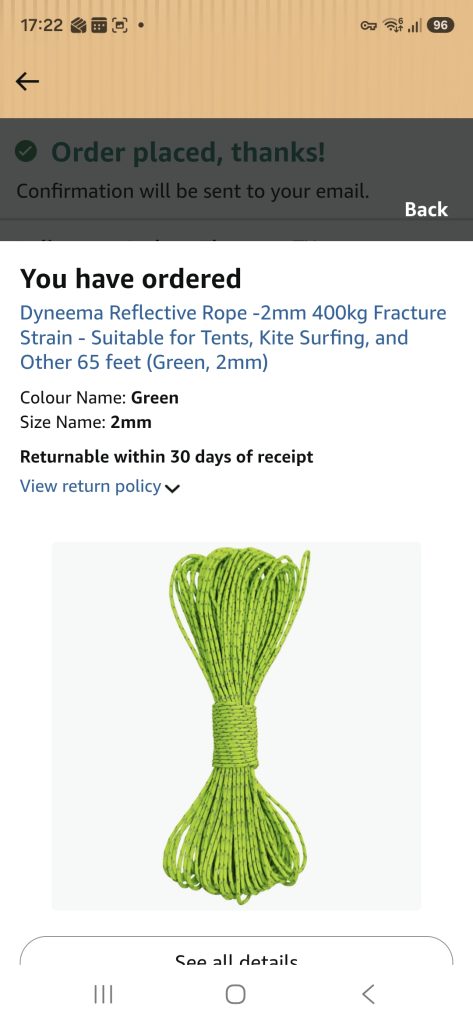
Material I purchased for LRO-H2 after the analysis above: